Pages

Showing posts with label iran. Show all posts

08 February 2012

RAF helicopter death revelation leads to secret Iraq detention camp.


Death in RAF helicopter and secret prison camp in Iraq desert raises questions about legality of British and US operations.
Latif Yahia,Iraq,USA,CIA,Uday Saddam Hussein,America,War
An RAF helicopter in Iraq.
On the evening of 11 April 2003, a pair of RAF CH47 Chinook helicopters swept over Iraq's western desert towards a remote rendezvous point beside Route 10, the highway that begins life on the outskirts of Baghdad before running for mile after mile towards the border with Jordan.

As they approached their destination, the crews assumed they were on an operation that would be uneventful. Two days earlier Saddam Hussein's statue had been toppled after American tanks rolled into the Iraqi capital; three weeks later George Bush would stand in front of a banner saying "mission accomplished".

The helicopter crews had been told that a number of detainees were under armed guard at the side of the highway. They were to pick them up after dark and take them to a prison camp. What followed was far from routine: before the night was out, one man had died on board one of the helicopters, allegedly beaten to death by RAF personnel.

The incident was immediately shrouded in secrecy. When the Guardian heard about it and began to ask questions, the Ministry of Defence responded with an extraordinary degree of obstruction and obfuscation, evading questions not just for days but for weeks and months. The RAF's own police examined the death in an investigation codenamed Operation Raker, but this ended with some of the most salient facts remaining deeply buried. The alleged culprits faced no charges.

Asked where the men were being taken, the MoD had initially indicated that they were en route to a prisoner of war camp, one inspected regularly by the Red Cross.

Later it became clear that this was not correct: they were being transported to an altogether more secret location. The truth about the mission raises some searching questions about the legality of some of the British forces' operations carried out in close co-operation with US allies.

One of the first hints that something untoward had happened aboard one of the RAF Chinooks came six years later when Lieutenant Colonel Nicholas Mercer was giving evidence at the public inquiry into the death of Baha Mousa, the hotel receptionist tortured to death by British troops in September that year.

Mercer, who had been the British army's most senior lawyer in Iraq, told the inquiry that by the time of Mousa's death, several other people had died in UK military custody.

Asked about these mysterious deaths, the Ministry of Defence named one of the deceased as Tanik Mahmud, and said he had "sustained a fatal injury" while travelling aboard an RAF Chinook. Perplexingly, the ministry added that the cause of his death remained unknown.

'Unlawful killing'Asked how they could be sure he had suffered a fatal injury when the cause of his death was not known, the MoD took five weeks to answer.

Eventually, officials admitted that the RAF had received a complaint – anonymously, they said – that "three RAF Regiment personnel on board the helicopter had kicked, punched or otherwise assaulted Mr Mahmud leading to unlawful killing".

This raised many other questions, which the MoD appeared sometimes reluctant to answer.

One of the few that it answered promptly – within hours – concerned the location to which the prisoners were being taken. They were going to Umm Qasr, the MoD said: this was the town on the Kuwaiti border where British and American forces had constructed a large prisoner-of-war camp, a place that came under the supervision of military lawyers and was inspected regularly by the Red Cross.

More information about the incident was to be found in a number of documents released in Australia under that country's freedom of information laws.

The deceased had been one of 64 men detained at a roadblock set up by a soldiers of the Australian SAS. Working alongside a solitary member of a US airforce unit, the 20 Australians were attempting to capture so-called "high-value targets", former high-ranking members of the deposed regime attempting to flee the country.

Seven days earlier, Saddam had appeared suddenly in the middle of a crowd of cheering supporters, an event that was filmed and broadcast on Iraqi TV, along with a speech he was said to have made in which he exhorted his countrymen to "fight them brothers, hit them day and night". The coalition forces were determined to find him.

Three of the prisoners at the side of the highway were suspected of being officials of Saddam's ruling Ba'ath party. Four were held because they were Iranians and in possession of an enormous sum of cash – more than $600,000 – and a letter offering a bounty for each American killed.

The remainder of the prisoners appear to have fallen under suspicion because they were travelling together on a coach. Some were Iraqis and others were Syrian, and all were to be interrogated about Saddam.

None of the 64 were armed, however, and none were in uniform. A number were middle-aged and at least one was severely disabled. Despite this, the men were to be detained as EPWs, enemy prisoners of war. They were to be loaded into the Chinooks in groups of eight and ferried to the prison camp.

As a result of what might be described as a legal sleight of hand, the men were never recorded as prisoners of the 20 Australians. On paper, at least, the lone American was said to have captured them. This meant that the Australian government could consider itself not to be bound by a Geneva convention clause that obliged it to demand the return of any prisoner it transferred to the US if it became apparent that US forces were not treating them in accordance with the convention.

At this point in the Guardian's inquiries, a report written by the squadron leader commanding the 2nd squadron of the RAF Regiment was leaked.

This document, prepared as part of a brief US field inquiry into the incident, showed that the Australians had bound the prisoners' thumbs together before handing them over.

The RAF Regiment gunners then placed hessian bags over the prisoners' heads as they were being led aboard the Chinooks, despite a ban on hooding imposed on the UK's armed forces more than four decades earlier.

Knelt uponEach prisoner was forced to lie face down on the floor of the aircraft, and those who "refused to adopt the required position" were forced to the floor and knelt upon.

One man who slipped out of his thumb restraint and flailed his arms around was said to have been "lowered" to the floor and "subdued".

By the time the helicopters had reached their destination, two of the prisoners "were found to be unresponsive", according to the squadron leader, while "there was some commotion at the front of the aircraft" because a third prisoner, a disabled man, had somehow parted company with both his prosthetic legs.

It was a windy night, the sand was being whipped up by the Chinooks' rotor blades, and visibility was down to 1.5 metres. The American troops who received the prisoners say the British appeared to be rushing, anxious to transport them all before dawn.

The two "unresponsive" men were loaded into the back of a Humvee vehicle, face down and on top of each other, while the man with no legs was placed in the front passenger seat.

All three were driven to a "holding facility", where one was declared dead. The bag had been taped so securely over his head that it needed to be cut off.

The US inquiry concluded that "appropriate" methods had been used to subdue the man who died. The RAF made no attempt to contact next of kin to inform them of his death, however. Were it not for the anonymous complaint, this would have been the end of the matter.

The complaint is understood to have been made by a member of the Chinook's crew, unhappy at what he saw happening in the helicopter's cabin as they were flying to the camp. After receiving the complaint, the RAF police moved slowly.

According to the MoD, they waited more than a year after the death before asking an RAF pathologist whether the body should be exhumed and examined. Asked to explain the delay, the MoD said the investigators "did not know Mr Mahmud's place of burial".

Once the location was disclosed by the US military, officials explained, "discussions took place on the feasibility of accessing Mr Mahmud's remains, taking into account serious security concerns and obtaining permission from the local imam". At this point, according to the MoD, the RAF pathologist "indicated that given the climate and the degree of decomposition since the death, it would be extremely difficult to establish cause of death". As a result, no postmortem examination was ever carried out.

This advice surprises one eminent civilian pathologist, who says that only exhumation could reveal the state of decomposition.

Derrick Pounder, professor of forensic medicine at the University of Dundee, who has experience of exhumations and postmortem examinations in the Middle East – including cases of deaths in custody – said: "That advice would be contrary to the advice that any UK forensic scientist would offer to any police in the UK who were investigating an allegation of assault leading to death."

He says an examination of the hard tissue may have revealed evidence of an assault before the prisoner died: ribs, for example, sometimes fracture in a distinctive manner when kicked. Asked whether a copy of the pathologist's advice would be made available, the MoD said no copy could be found in its files. After this advice was received the case was passed to RAF's prosecutors, who advised that there was insufficient evidence to bring any charges. They also concluded that any further investigation was pointless.

Asked why the men had been taken as EPWs, when none were armed and all were wearing civilian clothes, the MoD appeared to be stumped.

"UK forces did not detain these individuals, they transported them," the ministry said. "This is not a question we can answer. This question should be directed to the detaining country."

Eventually, the Guardianobtained a copy of the passport that had been in the dead man's pocket, and the death certificate that had been issued by the US military authorities. The passport showed the dead man was a Baghdad odd-job man aged 36. It also showed that his name was not Tanik Mahmud, but Tariq Sabri al-Fahdawi. The RAF police investigation appeared to have been so superficial that it had failed to establish the dead man's identity.

Unknown cause of deathThe certificate recorded Sabri's cause of death as unknown. It also showed that the whereabouts of his grave, far from being uncertain, could be pinpointed precisely. The American officer who completed the certificate had gone to considerable lengths to ensure it could be found, beyond the airfield perimeter: "700m out front gate to first culvert, 191 degrees for 50m, next to grave with stacked stones in same location ..."

But of greater significance was what the death certificate revealed about the location of the airfield. It showed that the 64 prisoners had not been flown to the prison camp at Umm Qasr at all. They had been taken an airfield codenamed H1, described on the certificate as the forward operating base of a US special forces unit known as Task Force-20. H1 was an airfield built next to an oil pipeline pumping station.

It was 350 miles north-west of Umm Qasr, in the middle of Iraq's western desert, a vast and desolate expanse of sand and scree. The nearest settlement was many miles away: it is difficult to see how there could have been a "local imam" whose permission needed to be sought before exhumation, or how anyone in the vicinity who could pose "serious security concerns".

The holding facility at H1 was not inspected by the Red Cross. Moreover, its existence was not disclosed to Lieutenant Colonel Mercer, the UK's most senior army lawyer in Iraq at the time. Mercer says he was "extremely surprised" to learn of its existence.

He said: "This matter potentially raises very serious questions. Strenuous efforts were made at all times to ensure that all prisoners were accorded the full protection of the Geneva conventions and vigorous objections would have been raised if there was the slightest possibility of a breach of the conventions. It appears from the information disclosed that some prisoner operations were being conducted, deliberately or otherwise, outside of the chain of command."

The holding facility appears effectively to have been a secret prison – a so-called black site. It is entirely possible, according to international law experts, that taking prisoners to H1 could amount to "unlawful deportation or transfer or unlawful confinement", and that the prisoners were subjected to "enforced disappearances", both of which are war crimes under the Rome statute of the international criminal court.

One former RAF Regiment trooper who was based at H1 for several months has described being involved in a number of similar missions in which prisoners were collected from coalition special forces. This always happened "under total darkness", he says. On arrival at H1, the prisoners were handed on to people whom he describes as "other authorities".

Could this explain why the police investigation into the alleged killing of Tariq Sabri ended with some of the most basic facts – such as his name and the the cause of his death – remaining unknown?

According one well-placed source with knowledge of Operation Raker, the RAF police investigation into the death, there were some at the MoD who were concerned about the possible consequences of a more thorough inquiry: people who were filled with dread at the thought that it could lead to accusations that British forces and others had been involved in crimes against humanity.

When the MoD realised that the location to which the prisoners were flown was known to the Guardian, it quickly apologised for previously stating that they had been flown to Umm Qasr. This had been an innocent mistake, one that a spokesman said could be attributed to "admin/human error".

At this point the MoD also released a copy of the US field inquiry report, which had been withheld from the Guardian for more than a year.

The report showed that a British special forces unit known as Task Force 14, and an Australian unit known as Task Force 64 were an integral part of operations at H1. Both units were under US tactical control.

The ministry also volunteered an admission that the investigation into Sabri's death was not conducted quickly enough. But it said that this could not happen today as its procedures had changed, and added that Operation Raker was now the subject of a review by a team of military police and former civilian detectives known as IHAT – the Iraq historic allegations team.

Asked whether there was any truth in the suggestion that officials had interfered with the investigation into Sabri's death in order to suppress information about the UK's involvement with H1, the MoD replied that IHAT was "giving consideration to any involvement with the investigation of MoD officials who were external to it", and that it would be "inappropriate to comment" while that review was continuing.

Geneva conventionThe MoD was also asked whether it was satisfied that UK forces serving at H1 had never been in breach of the Geneva convention, or any other international humanitarian law. It replied by stating only that IHAT would consider the actions of those who came into contact with Sabri.

Nor would the MoD comment on another claim made by the source with knowledge of Operation Raker: that both CIA and MI6 officers were involved in the interrogation of prisoners flown secretly to H1, and that these were the "other authorities" whom RAF Regiment troopers were told would be taking possession of their prisoners. The ministry's only response to questions about non-military interrogators at H1 was a terse: "No further information."

The involvement of the CIA in Task Force 20 is no secret in the US, where it has been disclosed in Pentagon statements and congressional testimony. According to Human Rights Watch, the inter-agency unit was responsible for "some of the most serious allegations of detainee abuse" following the invasion.

Before the end of that year, the unit merged with a similar unit previously based in Afghanistan and changed its name to Task Force 121. By then, however, some at the Pentagon were sufficiently concerned about its methods to send a special investigator to Iraq. Stuart Herrington, a retired military intelligence colonel, discovered that the unit was holding undeclared "ghost" detainees and operating a secret interrogation centre to conceal its activities. Some of its prisoners showed signs of having been beaten.

This was several months before the abuses at Abu Ghraib became known, and Herrington's top-secret report shocked some in Washington. Eventually, somebody leaked it.

Over the years that followed, the unit changed its name again, to Task Force 6-26, and later to Task Force 145, possibly in an attempt to confuse adversaries. Its precise size and the names of its commanders have never been disclosed. But its methods appear to have remained the same. The American Civil Liberties Union obtained a series of US defence documents that showed that the unit's personnel had been investigated repeatedly over their alleged involvement in a catalogue of abuses. In one case, taskforce interrogators were said to have forced a 73-year-old woman to crawl around a room while a man sat on her back, before forcing a broom handle into her anus. Two of her fingers were broken. The woman, a retired teacher, said her interrogators demanded to know the whereabouts of her son and husband, both of whom she said were dead.

In 2006, an investigation by the New York Timesfound that some taskforce prisoners had been water-boarded, and others were beaten or shot with paintball guns. While a number of interrogators had been prosecuted, posters around one of their bases proclaimed "no blood, no foul": they would be safe as long as none of their subjects bled. The ultimate destination for some of the prisoners who passed though this base was said to be Abu Ghraib. The newspaper's investigation did not uncover the continuing UK involvement with the taskforce, however.

But this became clear when one British member spoke out after quitting the army in disgust. Ben Griffin, a young SAS trooper, said the unit was capturing hundreds of people who were being rendered to prisons where they faced torture, and that he had witnessed dozens of illegal acts by US troops. "My commanding officer at the time expressed his concern to the whole squadron that we were becoming the secret police of Baghdad," Griffin said. The MoD responded by obtaining a court injunction to silence Griffin, and warned he faced jail if he said any more.

The review of Operation Raker being conducted by IHAT is nearing completion, and a report is expected to be handed to the head of the RAF police at the end of this month. The MoD says it is not going to be published.

06 February 2012

How the American administration and the CIA created terrorists and mass-murderers

National Security Advisor Zbigniew Brzezinski visited Afghanistan in 1979:
This is what he said to the Mujahideen in Afghanistan.
"We know of their deep belief in God, and we are confident their struggle will succeed. That land over there is yours, you’ll go back to it one day because your fight will prevail, and you’ll have your homes and your mosques back again. Because your cause is right and God is on your side"

Former British Foreign secretary, Robin Cook said:
"Bin Laden was, though, a product of a monumental miscalculation by western security agencies. Throughout the 80s he was armed by the CIA and funded by the Saudis to wage jihad against the Russian occupation of Afghanistan.'

Hilary Clinton admits that the American government created, supported and supplied the Mujahideen in Afghanistan in the 70's, these Mujahideen became Al-Qaeda, the Taliban and the Brotherhood of Islam. The very terrorists that they now fight in their "War on Terror".

Yes Mrs Clinton They created them and we pay the price.

Mr. Obama, President of the United States of America welcomes the mass murderer Noori Al-Maliki to the Whitehouse and says without shame that Iraq is a safe, independent, sovereign state in which Al-Maliki is a Democratically elected leader.
Yes Mr. Obama, in Al-Maliki's democratic Iraq there are 138,000 in prison and an unknown amount in secret prisons, seven of which have been discovered recently. During the dictator Saddam Hussein's reign we had 14,800 prisoners -this information was found after the 2003 invasion-
Half of the number of prisoners held under Al-Maliki's democratic government have not been afforded legal aid, a court hearing or visitation by family members, in fact once they are handcuffed and removed from the family home or wherever they are arrested ,no other news is ever passed on the family of their whereabouts or legal standing. Under this "Democratic Government" that America supports, Iraq has no electricity, no clean water, no infrastructure, no justice and no human rights. Presently there are 3 million Iraqi refugees inside Iraq -mostly since the civil war from 2006 until now- something that is not reported in the western media as it would be evidence of Americas failure. 5 million Iraqi refugees outside of Iraq and over 1.5 million killed. There are 1 million widows.
A special thanks also to you Mr. President, for your presentation of Iraq as a gift to Iran on a golden plate.
The irony of the situation is that when America chooses to go to war with another country it uses "Human Rights violations" as it's first tool in the propaganda machine. Where are the Human rights in Iraq now?

A special thanks from me to your CIA, well done and thank you for having me put on the "terrorist watch list" in Ireland, it only goes to back-up my belief that if you are honest, speak out for your people and country, have a manner or dignity, you are a terrorist in the eyes of American foreign policy.  We all know that Ireland -the state not the people- will always believe what you tell it to, it is a state of America not Europe, and even if it were to try some independent thought you would keep it in line by threatening to send all the Irish illegal immigrants home, just like your predecessor Mr. Bush did when the Irish government didn't want to open Shannon airport to the US Military or rendition flights. If having dignity and manner, speaking out for my country, it's people, justice and human rights around the world makes me a "terrorist" in your eyes, well then sir, I will wear that title proudly.

28 October 2011

Sleeper cells, continued.
Mehidi Army in New Iraq?

Where to begin? Some years ago I wrote an article about Iranian sleeper cells, their function and goals. It was widely ignored, especially by the Irish Intelligence services, nonetheless with the recent attempted assassination of The Saudi Ambassador to the US, people may be starting to pay attention. In the first few articles that came out about the attempt, the American Intelligence services were saying "what are the chances that a used car salesman is an assassin?" well, isn't that how sleepers work? They live as very, very, everyday, normal, don't do anything to draw attention to themselves, "beyond reproach" people. Why wouldn't a used car salesman be a sleeper? That's the kind of cover they need, invisible.

America made it's perfect excuse to go into Afghanistan and Iraq when it fabricated Al-Qaeda (see my other blog), but it also gave Iran it's perfect means of spreading its Jaysh al Quds (Army of Jerusalem) Refugees. I am not saying that all refugees are sleepers, that would be far too much of a generalization, what I am saying is that some refugees, especially those from Iraq, were not even Iraqi never mind true refugees, Iran used the Iraq/Iran war to send out it's first wave and the "War on Terror" to replenish their numbers (it is hard to stay ideologically pure when surrounded by temptation)
 
I think that the time is right to explore why people become "extremists" what drives someone to be a suicide bomber for instance? Well, obviously there are the fanatics, religious or otherwise that believe their way is the only way and are who willing to sacrifice their lives and yours for their cause.
Then there are the people who started out without any particular convictions, who, during the course of their lives witnessed and suffered such cruelty and injustice that they lost all hope and were taken in by fanatics, these people are victims, their pain and suffering is taken and twisted by the true fanatics, they are given an enemy, someone on whom the blame can be placed and sent off to do the fanatics bidding. They are damaged people and they are used in the worst possible way.
Please, please do not believe that fanatics are confined to the Muslim faith, there are Christian, Jewish and many other types too. Recent events in Norway have proved this.

Before I continue I will make this statement again, just in case you haven't read any of my other articles and also to explain.
I am not anti-Shia, while growing up in Iraq we did not have such a divide, everyone celebrated whatever it was with whomever, Shia, Sunni, Kurd, Turkmen, Christian, nobody bothered.
For those that don't know or understand the differences between Sunni and Shia for example, the Sunni came first, Sunnis are followers of the Prophet Mohammed (PBUH) the Shia or Shi'ite came later when Hussein the son of Prophet Ali was killed in Kuffa, Iraq,(which is why you will see them slap themselves, it is to cleanse them from the sin of his and his families murder) they follow the teachings of Ali, whom they believe should have received the miracle of the Q'uran instead of Prophet Mohammed although Ali was nine at the time, when the Angel Gabriel came down to give the news to Prophet Mohammed that he shall bring the Q'uran to the world, he was sleeping in Ali's bed.
I suppose it is similar to the difference between Catholic and Protestant and with just as much divisiveness these days. I think the true test of any religion is when you don't have to kill in the name of it.
There is also a difference between Iranian Shia and Arabic Shia, when I use the term Shia or Shi'ite I am referring to  the Iranian Shia that follow the Ayatollahs, A lot of Arabic Shia were opposed to the war of 2003 and supported Iraq.

With regard to Saddam Hussein and his regime, he was an equal opportunity employer ( he employed Sunni, Shia and Kurd etc) and an equal opportunity killer, if you committed a crime against Iraq/Saddam it made no difference to him what creed your name came under.

No organisation would be able to function without a network, so in the next paragraph or two I will give an example of how the "wrong" kind of people can claim asylum in your country. I'm using a case in Ireland that I have made the authorities aware of but they have done nothing about.

Pre-2003 there were three Mosques in Dublin, the very large one in Goatstown, a smaller one on the South-Circular road and a Hussainiya at Dundrum Bridge.
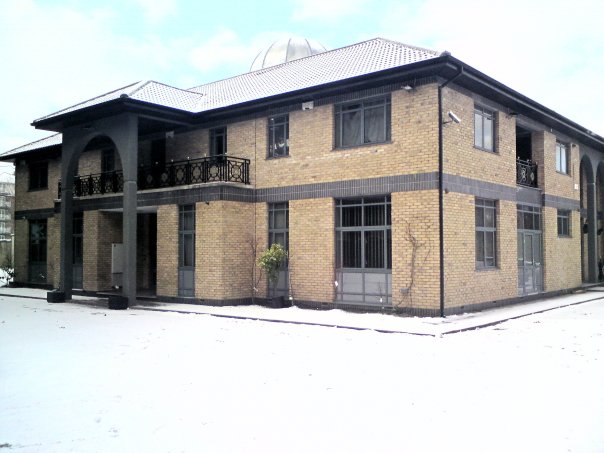
Hussainiya at Dundrum Bridge

Al Hussain House,Dundrum Bridge, Dundrum road. Dublin, Ireland.
The Sheikh or Imam at the Hussainiya is called Abu Hassan originally Ali Al Saleh a Shia from Saudi Arabia, he started out as a Doctor but changed his image from suits and ties to Djellabas and Imama (a sheikhs turban). This was quickly followed by a trip to Iran and Saudi Arabia to set in motion the funding of a larger Shia presence in Ireland, the Sunni Saudis had already built the large Mosque in Goatstown. The Shia Saudis funded the Hussainiya at Dundrum bridge, headed by Abu Hassan. So with cash in his pocket Abu Hassan built the larger Hussainiya on land that had once belonged to a foreign student, when the student had finished his education he returned home, Abu Hassan seized the opportunity, he bribed a solicitor and had the deeds changed over to his name.
The Hussainiya also houses small rooms upstairs where he homes refugees and bills the Irish State. Over his years here Abu Hassan has built up a relationship with many refugees and Irish politicians, some of those refugees have become translators in the Department of Justice. Abu Hassan has also become the "go to guy'" for the Irish intelligence service and the Special Branch, his character reference is enough of a guarantee for them.
Ali Al Saleh , Abu Hassan

With Abu Hassan's help people from Bahrain (who speak Arabic with an Iraqi accent) and Saudi Arabia claim asylum as Iraqis, Abu Hassan makes his translator friends in the Department of Justice aware that they will be in for interview and to back up their story or correct them while they are in the interview.
 It is a big part of the Shia culture to be able to cry, they cry very openly at religious festivals etc and are able to use this to great effect in their interviews. In the Shia religion anything that you do in "an infidels/non-believers country" is okay, you may. lie, cheat, steal, sleep with their women, anything to get what you want because they are unbelievers and God will punish them anyway.
 If the interviewer still isn't convinced Abu Hassan also has connections in Iraq to provide him with whatever forged document that the refugee needs, the prices for such services range from 250-500 euro depending on the document. 1,000 euros for the forged deeds to a house in Iraq.
There are now more than thirty Husainiyas in Ireland, each person that attends a Hussainiya pays a tithe equivalent to a percentage of their wages/social welfare. There is so much money flowing to Abu Hassan from Iran, Saudi and the Khumus(tithes) that he doesn't know what to do with it, except maybe buy more property and expand his Hussainiyas. In these times where a lodgement of over 5,000 euros is questioned does no one ask Abu Hassan where his money comes from? Or has the recession hit so hard that they don't care as long as he's bringing it into the country?
I have proof of this and the address of every house that he owns.
Abu Hassan's property portfolio since the fall of Saddam in 2003 stands at, 95 houses, the asking price pre-recession was between 280,000 euros up to 900,000 for one he owned in Ballsbridge. He owns restaurants, Barbers a limousine company, dry cleaners and properties in Dubai. Most of these properties and businesses are in other people's names, with the business name taking a 10% cut for running the business.
The newest addition to the services that the Hussainiyas provide is Mutha. Mutha is a marriage for a short time, so that the participants may engage in martial-sex and then divorce afterwards. The fee is 200 euros, payable to the Hussainiya, unless the woman is a virgin and then the "husband" is obliged to pay 5,000 euros. Those wishing to participate may choose a partner from pictures in an album, supplied by a woman whom I won't name but is known to the Irish authorities and works as a translator in the Department of Justice. The proceeds of Mutha are divided 60/40 to Abu Hassan and 40 to the woman. Many Irish women who have converted to Shia through the Hussainiya have been duped into putting their photos in this book in the hopes of finding a husband, they do find one but never longterm.
Brothels may be illegal in Ireland, but through Religious Freedom it seems the red lights shine.

As with Abu Hassan and the case below, I and other like minded people have been watching these people who bring shame to the Nation of Iraq and Islam. Even though I am not religious. We decided that giving information to the Western governments as they are already aware but choose to do nothing is pointless. So all the information that we have about Abu Hassan and people like him here in the west, is being used for the future. When Iraq is a true Nation once again, these people will be sought so that Iraq may reclaim the money taken from it, that it may be put to use rebuilding Iraq and  giving aid to the people who truly need assistance.
These examples are just from Ireland, there are many others like these men in Canada, America, Sweden, France, Germany, Britain and Australia etc.

One interesting refugee actually from Iraq but with a false asylum claim is General Muttar Hameed Jabir al-Mohamedawi born  01/07/1957 and married to Intissar Anwar Daoud born in 1961 a Christian who converted to Islam. In his asylum claim Muttar says that two of his sons were killed in Iraq and that he was a "High Ranking" Ba'ath party member and therefore cannot return to Iraq for fear of being killed, he has provided the Irish authorities with documentation to support his claim, but in a country that is now built on fraud should anyone really believe them?
Muttar Hameed Jabir al-Mohamedawi
Muttar received his title of General in the Iraqi Police from the Mehidi Army (who are backed and funded by Iran) it was an honour bestowed upon him, something that would never happen if he was Ba'ath party. Also Muttar travels back and forth to Iraq through Syria using Iraqi passports, the reason for his travel is business, the business of detaining people in his Iraqi Police cells and keeping them there until their families pay up. No one is released until he returns to Iraq from Ireland.
He is also responsible for organised kidnappings, when he is unable to return to Iraq the money is lodged to his various Irish bank accounts via Dubai by his brother-in-law, from his "business" he receives hundreds of thousands of euros a month. Muttar has also openly admitted that he has killed seven people, all from the same family, a Father, three children, two cousins and one other male relative, the reason? They allegedly killed one of his cousins. I passed this information to the Irish Intelligence service about a year ago, their reply, well.. it'll take some time... In the meantime he was granted refugee status.

Before 2003 there were maybe three Shia channels on Iraqi Television, now there are hundreds, all preaching that they (the Shia) are victims. That under Sunni rule they were killed, had no religious freedoms and were subjugated. Under Saddam's rule which I mentioned earlier he killed anyone, he outlawed the practice of whipping yourself which the Shia do during Ashur and many new festivals they have now, because the body is a temple and should not come to any harm especially by one's own hand. Some Muslims won't even pierce their ears. As for subjugation, well the whole of Iraq was under his hand wasn't it?

Mahmoud Ahmadinejad with Israelis??

You may like to consider the above an exaggeration, but if you go to Iraqi history and delve into the regime's role-call and Ba'ath Party register you will see that over 75% of the members of the Iraqi police, the Prison guards, Fidayeen Saddam the Militia run by Uday Saddam Hussein but who after the fall of Saddam swapped their black uniforms for black Mehidi Army uniforms, General's, all of the higher echelons of Iraqi society had more than 50% of Shia participants. 

Iran, it's followers and sleepers have already invaded the West, since 1979 when the Shi'ite Islamic revolution happened the Mullahs put their plan into action. Their goal, that the world convert not just to Islam but to Shi'ite.  Iran told America 'If it wasn't for us, you couldn't put one foot in Iraq!' and it is true that without Iran, America couldn't have gone into Iraq or Afghanistan. This rhetoric from America that Iran is part of "the Axis of evil" is just that, America, Iran and Israel are holding hands in an attempt to conquer the Middle-east. Infiltration is the preferred method. Three or four years ago Iran tried to infiltrate Morocco, the government became wise to their tactics and closed the Iranian Embassy there and turned it into a public toilet.
After the fall of Mubarak they tried to invade Egypt also, they started supporting a publisher and printer in Dumyiat that printed Shi'ite literature, the Egyptian government were alerted and they deported all the Shi'ite that had already arrived and have made it very hard for Iranian shi'ite  to enter.
During the Invasion of 2003 and the following years, 80% of the refugees that America took in from Iraq were Shia, if the Shia were not working with or for America why should they take them? Iraq was and is under Shia control, Saddam was over, why should they be refugees?

Al Hussain House in Dublin Not Iran.

10 October 2011


And the threats continued once Ali Taleb and his family were in Sweden. They received threatening telephone calls from Iraqi numbers and on one occasion Ali Taleb was attacked and stabbed in the street.
 

Journalist to be deported despite death threats.

The Swedish Migration Board has decided to deport a well-known Iraqi journalist and documentary maker back to Iraq. This is despite Ali Taleb having received death threats following his film about the notorious Iraqi paramilitary force, the Mahdi Army.
Ali Taleb

The decision to deport Ali Taleb from Sweden has been strongly criticised by Reporters without Borders. Urban Löfqvist is the head of the Swedish section:
“Our assessment is that Ali entirely fulfils the criteria for asylum, partly because he has been threatened in his home country of Iraq and partly because he has had threats made against him in Sweden. The migration board has been bloody-minded in its interpretation of many of the facts in this case.”
Freelance journalist Ali Taleb fled with his family to Sweden three years ago and sought asylum. In Iraq he had received numerous death threats and his wife had been injured in a bomb attack. The reason was Taleb’s film about the Shia Mahdi militia, which in the past have fought against the US presence in Iraq and are also accused of murder and abuse against Iraqi civilians. After the film was aired on television, several of those who appeared in it were arrested. It was then that family members of those arrested started to threaten Taleb and his family.
“I received several threats, first via phone and then in the post. At first, I thought the purpose was just to scare me, but then I realised that they were out to kill me and my family,” says Taleb.
Swedish Migration Board
Despite this, the Swedish Migration Board judged Ali Taleb’s grounds for asylum to be insufficient and his application was turned down.
“When I received the decision of deportation I was shocked,” says Taleb. "I sought protection in Sweden as a journalist. I would have been better treated in many other countries. How can they treat me like this in Sweden?”
Cecilia Gylling Lindqvist at the Migration Board’s legal unit refuses to comment on any individual cases, but says that the situation in Iraq has improved, even for journalists.
“The security situation in Iraq has improved considerably of late and there are numerous newspapers and TV stations that are blossoming.”
Urban Löfqvist of Reporters without Borders does not agree:
“It is extremely difficult for journalists in Iraq. What we have seen, as an organisation, is that the number of attacks against journalists in the country is once again on the rise.”
Ali Taleb is currently in a migration detention centre outside of Stockholm awaiting deportation back to Iraq. Reporters without Borders believes Taleb’s life will be at risk if he is sent back. Ali Taleb himself says he shall continue the fight for him and his family to remain in Sweden.
“Let them bear the responsibility it they deport me. I intend to fight against it,” he told Swedish Radio International.
Here is the link for the full article, you can listen to the article as it was on radio, pay particular attention to the Swedish authority figure saying that Iraq is considerably safer and TV and newspapers are flourishing, yes the ones owned by the Shia clerks and Militias. Ali Taleb will be murdered if he is sent back to Iraq, do anything that you can, post this article on your Facebook, tweet, text, anything! we need to use our power to stop this kind of madness. I urge all of my friends in Sweden to show their support for  Ali Taleb, because today it is Ali, tomorrow it may be you!


 This is my answer to the authorities in Sweden and Western governments.
Ali Taleb is my friend, when he called me, as a humnan rights campaigner I called everyone that I could think of to help. I said to Ali, "Be strong, this is the face of the western governments, they don't really care about people or Human rights, just about money, power and contracts."
The Swedish government or any other Euorpean state welcomes the murderers, militia men and thieves because they bring with them the millions that they have stolen, an example of that is the Iraqis who moved from Malmo to Stockholm, in Iraq they were not the victims but the agressors, Mahdi militia and Badr brigade that is funded by Iran. Ali knows me very well, for the past twenty years I have tried to find a country to call home, but what I have found is that most of the European countries do not like people who are educated or with opinions, they like the criminals and thieves because they know that these people can be bought, bought by the country's social welfare payments and housing. The puppets in Iraq who have signed this "return" document have forgotten when they themselves were "refugees', now because of  the contracts and the money they are all blinded and have forgotten the humanity they once called for for themselves.

23 August 2011


Meet the real Devil’s Double: A conversation with Latif Yahia

 By Jenn Schanz

Could you live with the devil for five years? How about become him?
At only 23-years-old, Iraqi military official Latif Yahia faced both dilemmas, as the psychotic eldest son of Iraq's notorious dictator brought him to the edge of hell and back with a job offer.
Or rather, a job assignment.
To be a fiday, a double…
Adapted from Yahia's autobiographical book, the 2011 Sundance film "The Devil's Double" directed by Lee Tamahori and starring Dominic Cooper as both Yahia and Uday Hussein, is being called a "must-see summer movie" and the "Scarface of Arabia."
Latif Yahia
Latif Yahia
While Yahia praised the film and Cooper's performance, stating that "no one has played him [Uday] as well as Dominic….great performance," it's apparent that nothing about the film's inspiration was glamorous.
For five years Yahia, now a Ph.D and well respected author, endured torture, forced plastic surgery, and psychological torment at the hands of a man he calls "completely erratic" - Uday Hussein.
Yahia and Hussein became classmates in their adolescence but it wasn't until the closing of the Iran-Iraq war that Yahia was called summoned to undertake what would become the most heinous and disturbing task of his life.
Becoming Uday Saddaam Hussein.
Yahia recalls the emotional chords struck by certain scenes in Tamahori's film: "The scene that affected me the most was the torture scene where Uday is whipping me on the bench. It reminds me of all the torture that I suffered at his hands. The scene where he tries to have me kill the father of the raped girl, not just because I refused and slit my wrists but because, although the movie doesn't show it, Uday actually took the gun as I was bleeding and shot the man anyway, right there in his office."
Forced to duplicate Hussein's mannerisms, demeanor, and even dental alignment, Yahia assured me that Uday, as crazed and powerful as he was, never truly took hold of who he was.
"I never lost myself, if I had I would have given in to Uday's lifestyle and psychotic behavior as his "friends" did," Yahia says. "Always in the back of my head I would say "I am Latif Yahia, my father is Yahia, he raised me to be a strong and true man."
Reflecting on the most difficult aspects of his experience as a body double, the now husband and father recalled the anguish of witnessing Uday's treatment of women.
"Uday would find them anywhere and everywhere, if they didn't come willingly he had them abducted. He had his pimps bring groups of girls around and he would choose, whomever was leftover the pimps could have…. I believe they should all rot in hell."
While discussing film, which has not been shown in Iraq, Yahia also notes the sociopolitical impact "The Devil's Double" had on the Muslim world, and why U.S. involvement in Iraq has destroyed a connection to his homeland.
"Iraq has been brought back a thousand years, thanks. The Muslim people all know what their leaders are and how they behave, in Iraq we had one Saddam and one Uday, now we have hundreds, every Ministers' son acts in the way Uday did."
He continues, "Anyone who says Iraq is stable is lying, delusional, corrupt and/or working for the American government. I have no feeling for a country that is run by Iranians and occupied by American forces."
In 2003, Uday Saddam Hussien was killed along with his brother Qusay and nephew Mustapha during a U.S. Task Force 20 confrontation. Yahia was less than satisfied at hearing the news.
"I was FURIOUS! Not because he I liked him! I wanted justice! I wanted to see him in court, I wanted to stand in front of a judge and say ‘Look what this madman did to me,' I wanted the Iraqi people to get Justice, killing him was the easy way out. No one got closure or justice that day."
What is justice?
After reading Yahia's book and seeing the film, I am moved by the power of individual resilience and personal character, even when the world is trying to rip it away from you. Perhaps justice is the ability to propel forward, unscathed by the evils of one's past.
Having spent the last 15 years in Ireland, despite 105 letters to the Ministry of Justice in Ireland, Yahia still awaits to hear back from his third citizenship application. His previous two were denied.
"I will never give up my fight for free speech, freedom, and justice…I work for peace around the world, with people who believe in peace and humanity." Yahia is now working on what he refers to as a "controversial" documentary film, and seems to be following the promise made on his personal website.
"As my dearest friends and family say ‘I don't have a filter' but for me it's easy to talk about these things, I don't have a political party to toe the line in, I'm not affiliated to anyone or anything. Therefore I can speak the truth and the only one that will pay the price will be me. If I survive the release of the documentary."
Although Latif Yahia is still in search of a homeland, 19-years after the darkest chapter in his life, it seems that he is, in some way, at home with himself.
For more information on Dr. Latif Yahia's story or the film "The Devil's Double" visit www.latifyahia.com

23 May 2011

The Film of my life story,

The Devil's Double .

AL-Jazeera TV.

Saddam Hussein's elder son, Uday, was a man widely feared and loathed by the Iraqi people.
Famously cruel and violent, he had a reputation for raping schoolgirls and newly married brides, and reportedly once killed a member of his staff in front of a room full of party guests.
Latif Yahia attended the same school as Uday, and was noticed by the Hussein family for a particular trait -- he looked a lot like Uday.
At the age of 23, Latif was informed that he was to become Uday's body double. Refusal was not an option.
He underwent extensive training and plastic surgery to make their appearances more similar, and suffered numerous assassination attempts before fleeing to Austria in 1992.
Lee Tamahori's The Devil's Double explores Latif's traumatic experiences in the inner circle of a regime from which he is one of the few survivors. FPS talks to Latif and British actor Dominic Cooper, who took on the challenging double role of both, Latif and Uday.

07 April 2011

Collateral Murder

Overview

Update: On July 6, 2010, Private Bradley Manning, a 22 year old intelligence analyst with the United States Army in Baghdad, was charged with disclosing this video (after allegedly speaking to an unfaithful journalist). The whistleblower behind the Pentagon Papers, Daniel Ellsberg, has called Mr. Manning a 'hero'. He is currently imprisoned in Kuwait. The Apache crew and those behind the cover up depicted in the video have yet to be charged. To assist Private Manning, please see bradleymanning.org.

5th April 2010 10:44 EST WikiLeaks has released a classified US military video depicting the indiscriminate slaying of over a dozen people in the Iraqi suburb of New Baghdad -- including two Reuters news staff.

Reuters has been trying to obtain the video through the Freedom of Information Act, without success since the time of the attack. The video, shot from an Apache helicopter gun-sight, clearly shows the unprovoked slaying of a wounded Reuters employee and his rescuers. Two young children involved in the rescue were also seriously wounded.


The military did not reveal how the Reuters staff were killed, and stated that they did not know how the children were injured.

After demands by Reuters, the incident was investigated and the U.S. military concluded that the actions of the soldiers were in accordance with the law of armed conflict and its own "Rules of Engagement".

Consequently, WikiLeaks has released the classified Rules of Engagement for 2006, 2007 and 2008, revealing these rules before, during, and after the killings.

WikiLeaks has released both the original 38 minutes video and a shorter version with an initial analysis. Subtitles have been added to both versions from the radio transmissions.

WikiLeaks obtained this video as well as supporting documents from a number of military whistleblowers. WikiLeaks goes to great lengths to verify the authenticity of the information it receives. We have analyzed the information about this incident from a variety of source material. We have spoken to witnesses and journalists directly involved in the incident.

WikiLeaks wants to ensure that all the leaked information it receives gets the attention it deserves. In this particular case, some of the people killed were journalists that were simply doing their jobs: putting their lives at risk in order to report on war. Iraq is a very dangerous place for journalists: from 2003- 2009, 139 journalists were killed while doing their work.

02 March 2011

A New Era.
By : Latif Yahia

It was the best of times, it was the worst of times…..
I had better stop there or I’ll be charged with plagiarism, but, it is definitely an interesting time, especially for the Middle East. The spark that ignited that whole region of the world and gave hope to the idea of democracy or at least regime-leader change, has fully taken hold and now and there is no turning back.
As I watched the events unfold on television, I was struck by a mixture of elation at the fact that after forty or more years of rule, the people had had enough of their masters and were –for the most part- protesting peacefully for their removal and a sadness that this “liberation” was not the kind that Iraq had been able to achieve for itself.
Having said that Iraq had played it’s part in recent events, Iraq was held up to the rest of the Arab world as a ‘cautionary tale’ and example of ‘how Not to do it’ and when outside help was offered, the nations replied ‘No thanks, we’ll do this ourselves’ a lesson hard learned by Iraqis.
I send out my greatest respect to Tunisia and Egypt, who have made effective change without the loss of too many citizens and I send my deepest sympathies and respect to the families of those that did lose their lives in the protests.
I know that Tunisia and Egypt especially are open minded and progressive countries and will be strong enough to continue on their path to democracy, I can only hope that the other countries that are following in their footsteps –like Libya- will not succumb to extreme Islamists, something that is quite possible. Maybe that is why the drums are beating for Ghadaffi in a way that they didn’t for Ben Ali or Mubarak, add to that the fact that Libya holds nearly 5% of the world’s petrol and you have a recipe for America to go in there and secure it’s position. Unilateral sanctions only punish the people, not the regime. The regime have enough money outside the country to still be able to do and buy what they want, it is only the man on the street that feels the lack. It is estimated that Ghadaffi has 20 billion in London alone. While I am writing this, his money - 40 Billion in America and god knows how much in Switzerland- is being frozen.
Which leads me neatly on to my next point, an International court needs to be set up not just to hold Dictators, Tyrants and Despots to account, but those who supported the regime and I’ll explain this point clearly, a regime cannot function if it does not have suppliers, weapons, banking, business. A petrol filled country with a tyrannical leader cannot make money from it’s petrol if there is no-one who is willing to do business with them, they cannot keep control of their population if they cannot buy arms and their money is of no use if they cannot keep it somewhere safe outside their own country.
So often we are shown people like Saddam, held up high for us to despise and point at, but could or would he have survived so long if he didn’t have ‘friends’, let’s be clear here, business is the agenda of the day. Big business. It’s too easy to point the finger and say ‘Dictator, Despot, Tyrant’ but then under the table sell them billions of dollars worth of weapons so you can buy the oil cheap, the people who suffer are the citizens of that country.
But let’s also take a look at how these people get power, it could be argued that they took it by force, yes, but how did they get that “force”? somebody had to support and supply them.
I was a participant in a peace mission five years ago, and one of the other participants was a retired Colonel from the US Army, during this mission he tried to explain simply what the policy of the US was with regard to Non-US leaders, his explanation went something like this:
A country has a leader who is a bad guy, the US doesn’t like this Bad guy so we decide that he needs to go. He has an enemy who is not a really good guy, so we support the not good guy against the bad guy to get him out. But then after the not so good guy gets power he turns out to be a really bad guy.
Does that make sense?
My case in point is Noori Al Maliki, you only have to look at Iraq, the corruption (yet another Minister ran form Iraq yesterday with the best part of 100 million dollars), lack of any sign of progression since the installation of Democracy, the damning fact that 80 people have died in Iraq while protesting for change of the governing system, not the government. The fact also that none of this is getting any coverage in the Western media, why? Because, America doesn’t want to look like it has failed. But it has, America made so much noise about not letting Iran get it’s hands on Iraq but then handed the leadership over to people that it Knew were supported by Iran, Noor Al Maliki stood up a few days ago and said that nowhere in the world had democracy like Iraq, Iraq had the best democracy in the world, well if you call handing Ministries and positions of power over to people who haven’t been elected by the people Democratically, then I don’t know what the Yemenis, Bahrainis, Saudis or Libyans are demonstrating against, they already have democracy!
The leaders in the Middle East are in a state of panic, most of these leaders be they Presidents, Kings or dictators acquired their power with the help of Britain or America 40 or more years ago, the King of Saudi for instance has made an offer of 150 Billion dollars to buy Facebook! Why? Because he knows that through social networking the people are exacting change, they can mobilize and exchange ideas faster than the country’s intelligence service can track them. If he was a good leader why should he worry? If his people were happy why would they need to protest against him? As with most countries in the Middle East the power is held by the few, it is designed that way.

I wish all those who want change the best and send them my heartfelt support, I hope that those who succeed always keep in mind what it was to be downtrodden and instill in their children and the generations to come a sense of responsibility for their democracies. When we are complacent, tyranny has the opportunity to reign, when we say ‘ what can I do? I am only one’ we forget that that we are many and it is our voices that should be heard. When we say ‘ Uh, I‘m not going to vote, they’re all the same anyway’ then we let down not only ourselves and our country but the ones that had to fight and die for us to have these rights.
Never take your right to be heard for granted, you have heard the phrase ‘Use it or lose it’ and it is far easier to lose it than it was to get it in the first place.


23 January 2011

Sundance 2011, "The Devil's Double"

4:01 PM, January 23, 2011
By: Kyle Smith


Lee Tamahori's preposterous House of Saddam thriller "The Devil's Double" is a gimmick movie whose sole reason for existence appears to be the opportunity to let Dominic Cooper ("An Education") play both Uday Hussein (the whoring, disco-loving, degenerate psychotic son of the fascist dictator) and a soldier plucked out of the ranks to serve as one of Uday's body doubles. This family of evil cowards, of course, was said to have frequently sent doubles into dangerous situations and to strike heroic poses among the people.

Absolutely nothing about the film is credible except for the perverted sadism of Uday, but this vile monster's flaws are illustrated at nauseating length in scene after scene after scene of Uday disembowelling enemies, raping a bride on her wedding day and snorting cocaine. So what?

The movie is supposedly based on the memoirs of Latif Yahia, but anyone who's ever read anything about terror states knows how they work. Here's how they don't work: when Latif is plucked out of the 1980s Iran-Iraq war to be the devil's double, he at first refuses, then throws lots of tough-guy John McClane dialogue at Uday, confesses his hatred of Uday to his minders, steals Uday's car (twice) and his girlfriend (Ludivine Sagnier). After having seen a set of torture videos that vividly demonstrate what happens to those who displease Uday and his daddy. Talk about an anti-aphrodisiac: Latif sees images of a guy being treated to an electric drill inserted in his ear.

Maybe Latif is trying to portray himself as a heroic freedom fighter who conducted a one-man Resistance from inside the palace, but he wouldn't have lived 30 seconds if he had tried any of these things. And why would Uday drive around Baghdad with his clandestine double seated next to him for all to see? That rather defeats the purpose of having a double in the first place. Latif is there for cinematic reasons, to provide an audience surrogate to bear witness to the regime's depradations, not because it makes any sense for him to be present for Uday's parties and binges and picking up girls.

Ridiculous as all this is, the movie pumps it up into the realm of sheer fantasy during an absurd finale when Latif turns into a sort of Jason Bourne action man who easily steals a pistol and goes after Uday. Tamahori, who is best known for Hollywood hackwork like "Die Another Day," "Next" and "xXx: State of the Union," treats the horrors of the Saddam Hussein apparatus in exactly the same way. Such recent and horrific history is not to be handled in such a shallow, trifling fashion.

The Devil's Double

23 January, 2011
By Anthony Kaufman

Dir: Lee Tamahori. Belgium. 2011.
108mins

A crazy lurid vision of Iraq in its oil-rich heyday before and after the 1990 invasion of Kuwait, The Devil’s Double imagines Uday Hussein, the elder son of Sadaam Hussein, as a later day Arab Scarface. A Ferrari-driving, cigar-smoking, cocaine-snorting madman, Uday (Dominic Cooper) resembles a long line of compelling screen gangsters who crack up and maim people indiscriminately at the slightest irritation.

The film’s more fascinating relationship is between Uday and Latif, with Dominic Cooper pulling off the dual roles admirably.
When Uday decides he must have a body double, like those that protect his father, he recruits Latif Yahia (also Cooper), an army lieutenant with a striking resemblance, and makes him an offer he can’t refuse. “Think it over,” he says with a shit-eating grin. “You have 10 minutes.”

While the preposterous nature of the story could limit theatrical appeal, particularly in the US, where all things Iraq are a tough sell, The Devil’s Double should get its due internationally, with its salacious trappings and foreign stars driving considerable sales.

Based on a book by the real-life Latif Yahia, the film charts the man’s experiences within Uday’s ranks. Treated to videos of torture and threats to his family, Latif has no choice but to take Uday’s orders and sit quietly on the sidelines as the lunatic son commits a succession of outrageous acts, from slashing open the gut of his father’s confidante at a party to snatching schoolgirls off the street to rape and kill them. While Uday is pure evil, with no conscience or morality, Latif is his opposite: a trapped man who keeps his dignity.

Complicating matters is the presence of Sarrab, Uday’s sultry sexpot lover (Ludivine Sagnier), who appears to take a liking to Latif. It’s only a matter of time before Latif and Sarrab become romantically involved, though it may come as a surprise to know that their steamy sexual encounter occurs as US bombs are falling on Baghdad.

One can surmise that director Lee Tamahori (Once We Were Warriors, Die Another Day) and screenwriter Michael Thomas (Scandal) have taken some liberties with the facts of history. But such decisions only enhance the diabolical fun of The Devil’s Double. When Latif and Sarrab become involved in a shoot-out, steal a Mercedes, and then, after running out of gas, flee Baghdad on horseback, the movie tilts a little too far into campy terrain. It’s hard to keep a straight face when Sarrab says, “That night, we rode like the wind!” Sagnier mugs sexily enough throughout the film, but no amount of writhing can make the movie’s love story credible.

The film’s more fascinating relationship is between Uday and Latif, with Dominic Cooper pulling off the dual roles admirably. As Uday, his teeth slightly protruding, he’s a frenetic, giggling, high-pitched monster with a short fuse, who feels compelled to keep his newfound “brother” by his side. As Latif, he’s the honorable, stone-faced hero, cool as ice, waiting for the right moment to strike back. The special effects are first-rate, successfully sustaining the illusion of two distinct people on screen.

Production values, overall, are also top-notch, showing off the Hussein family’s gaudy playgrounds, palaces and pools in glossy Hollywood fashion.

Production companies: Corsan, Corrino, Staaccato, Tulchin Entertinment

International sales: Corsan World Sales, www.corsanworldsales.com

Producers: Paul Breuls, Michel John Fedun, Emjay Rechsteiner, Catherine Vandeleene

Executive producers: Harris Tulchin, Arjen Terpstra

Screenplay: Michael Thomas

Cinematography: Sam McCurdy

Production designer: Paul Kirby

Editor: Luis Carballar

Music: Christian Henson

Website: www.thedevilsdouble.com

Main cast: Dominic Cooper, Ludivine Sagnier, Raad Ravi, Philip Quast


21 January 2011

Hussein Wanted Soviets to Head Off U.S. in 1991

By: Michael R. Gordon
Published: January 19,2011


WASHINGTON — As the American-led ground offensive in the first war with Iraq got under way on Feb. 24, 1991, Saddam Hussein directed his frustration at an unlikely target: the Soviet leader Mikhail S. Gorbachev. Mr. Hussein had dispatched his foreign minister to Moscow in an 11th-hour bid to head off a ground war.

After prodding by Mr. Gorbachev, Mr. Hussein had offered to withdraw Iraqi troops from Kuwait in 21 days. But the United States appeared to be moving ahead with its land campaign.

“The situation is now is getting worse,” Mr. Hussein had written the previous night in an emotional letter to the Soviet leader. “Our nation and army are confused. We are asking ourselves which one is more significant: the Soviet Union’s proposal or the Americans’ threats?”

Speaking to trusted aides, Mr. Hussein was less diplomatic, denouncing Mr. Gorbachev as a “scoundrel” who lacked the will or influence to stay the first President George Bush’s hand. “He tricked us,” Mr. Hussein said. “I knew he would betray us!”

The disclosures about Mr. Hussein’s closed-door deliberations that first day of the Persian Gulf land war are documented in an extraordinary Iraqi archive, which includes 2,300 hours of recorded meetings and millions of pages of documents, that was captured by United States forces after the 2003 invasion.

On the 20th anniversary of Operation Desert Storm (the air campaign began on Jan. 17, 1991), three transcripts of Mr. Hussein’s fateful decisions are being released to coincide with a symposium in Texas on Thursday with Mr. Bush and members of his war cabinet. Only a small portion of the archive, stored in digital form at the National Defense University, has been declassified and opened to outside researchers. (A 2008 government report drew on the three Feb. 24 transcripts, but until now they have not been available in their entirety.)

The war’s history has been well documented, but the three transcripts provide gripping new details of what went on inside the Iraqi command, including Mr. Hussein’s anger at Mr. Gorbachev and his misinterpretation of the United States’ military actions.

With only fragments of information coming from the battlefield and a room full of subordinates eager to applaud the faintest glimmer of success, Mr. Hussein was convinced that the United States lacked the resolve to wage a grinding ground war, the transcripts show.

Even if the Americans suffered just one casualty for every four Iraqi casualties, he boldly predicted, the United States would falter. He lectured his aides that igniting Kuwait’s oil fields to hinder the allied warplanes was a valid military tactic that would not enrage the world. And he and his aides kept misreading the signals about whether the ground assault had even begun.

Studied along with a parallel archive of declassified transcripts at the George Bush Presidential Library at Texas A & M University, the captured Iraqi records depict Mr. Gorbachev as eager to engineer a solution that would protect the Soviet Union’s former Iraqi client and make the Soviets an equal partner with the United States in international diplomacy, but unwilling to jeopardize his relations with the Bush administration.

Mr. Bush emerges as a leader who sought to mollify Mr. Gorbachev even as the United States stuck to its demand for the unconditional withdrawal of Iraqi forces from Kuwait.

“It is your neighborhood, and some of them are your friends,” Mr. Bush told Mr. Gorbachev in a phone call on Feb. 22, 1991. “We recognize Soviet interests in the area. I want to get our forces out of there as soon as possible. I know how the Iranians and others feel.”

Jeffrey A. Engel, a professor at the Bush School of Government and Public Service at Texas A & M, noted that the exchanges showed that “despite heated discussions at the height of war with Iraq, Bush and Gorbachev were fundamentally concerned with safeguarding the future of Soviet-American relations.”

Iraq’s invasion and occupation of Kuwait on Aug. 2, 1990, were followed by months of demands that Iraqi forces leave the Persian Gulf nation, resolutions in the United Nations Security Council and a buildup of military might by the Americans and their allies in the region.

After the air campaign began in January, preparations for a possible ground attack in Iraq were stepped up. With the ground war just days away, Mr. Gorbachev mounted a peacemaking effort. Tariq Aziz, the Iraqi foreign minister, arrived in Moscow on Feb. 21. Later that day, Mr. Gorbachev told Mr. Bush in a phone call that he sensed a “serious shift” in Iraq’s position, according to a transcript in the Bush Library.

Iraq, Mr. Gorbachev said, was no longer demanding that resolution of the gulf crisis be linked to other issues in the Middle East. And although the Iraqis had initially demanded that they be given six weeks to leave Kuwait, the Soviets had insisted that the schedule be shortened to 21 days. That timetable still fell short of Mr. Bush’s demands that Mr. Hussein unconditionally remove his troops and pay reparations to Kuwait and that a plan be worked out to deal with Iraq’s poison gas, biological weapons and nuclear arms programs.

Mr. Gorbachev’s diplomatic efforts were undermined on Feb. 22 when the Kuwaiti oil well fires that Mr. Hussein had ordered set — and which he saw as a defensive measure — were described by Mr. Bush in his conversation with the Soviet leader as a “scorched-earth policy” and a reason to not delay military action. Mr. Bush said it should take the Iraqis no more than seven days to pull out of Kuwait, and he issued them an ultimatum to take action before noon the following day.

On Feb. 23, just minutes before the noon deadline, Mr. Bush and the Soviet leader spoke by telephone. Mr. Gorbachev argued that joint American-Soviet action through the United Nations would establish a model for dealing with other crises.

“George, let’s keep cool,” Mr. Gorbachev said. “Saddam wants to stall, but we are not simpletons.”

But Mr. Bush’s patience had been exhausted. “Mikhail,” he said, “I appreciate that spirit, but I don’t want to leave a false impression there is any more time.” If the Iraqis intended to comply with the withdrawal demand, he said, it would need to happen “in the next few minutes.”

In Baghdad the next morning, Mr. Hussein waited anxiously for word from his foreign minister, who had left Moscow. “When will Comrade Tariq arrive?” the Iraqi leader asked. Told that Mr. Aziz had yet to return to Baghdad, Mr. Hussein demanded: “What do you mean he has not arrived?” He read aloud a headline: “Tariq Aziz Arrives in Baghdad.”

As he waited for the minister to show up, Mr. Hussein instructed his subordinates to read a letter he had sent to Mr. Gorbachev the night before, asking the Soviet president why he was not doing more to oppose Mr. Bush’s decision to start the ground war. “We trusted you,” Mr. Hussein wrote.

The conspiracy-minded Iraqi leader seemed both baffled and angry.

“In typical fashion, he suspected that Iraq had been stabbed in the back, this time by disingenuous Soviet mediation efforts,” said David Palkki, the deputy director of the research center that houses the declassified Hussein archives.

Mr. Gorbachev’s reply was not reassuring. He wrote that Mr. Bush did not agree with the Soviet proposal, and that if Mr. Hussein wanted to avoid a ground war, he should immediately issue a statement saying that Iraq would withdraw its forces within 9 to 10 days, which was close to Mr. Bush’s seven-day timeline.

When Mr. Aziz finally arrived to see Mr. Hussein, the Iraqi leader greeted him with a laugh: “Are you up to surprises like Bush?”

To elude American warplanes, Mr. Aziz had returned via Jordan and traveled by road to Baghdad. Like two teenagers discussing the latest muscle car, Mr. Hussein and his foreign minister talked about how fast it was possible to drive on Iraq’s roads.

“We were going 220 on the highway,” Mr. Aziz said, referring to kilometers. That translates to more than 130 miles per hour.

Neither official put much hope in getting help from Iraq’s neighbors. One aide asked about Iran, whose eight-year war with Iraq had ended in 1988. “We are done dealing with the Iranians this time,” Mr. Aziz said. Added Mr. Hussein: “Like all new revolutions, they talk too much.”

With little accurate intelligence, Mr. Hussein and his command failed to grasp their adversary’s strategy. The Iraqis believed an American amphibious landing — a giant feint intended to distract Iraqi troops — was likely.

And Mr. Hussein initially mistook some probing actions by the American military as signs that a major attack had been mounted and contained. “If this is the initial shock,” Mr. Hussein said, “then the attack has failed.”

But as the day wore on, the seriousness of the predicament became more apparent. Frustrated at their inability to negotiate a compromise on their terms, the Iraqi officials speculated that casualties that the United States would suffer in a ground attack would lead Mr. Bush to soften his demands.

“Let us pray to God to grant us success to slaughter any number of them,” Mr. Aziz said. “That is what is going to help us get results.”

“Let them come to Karbala city,” Mr. Hussein said confidently. “It will become their cemetery.”